
Lighting is one of those things people think about least until it starts bothering them. A room that feels uncomfortably bright, a kitchen where chopping vegetables feels like a chore because you can’t quite see what you’re doing, or an office where eyes feel tired by midday — these are often lighting problems, not the result of bad design or poor architecture. Understanding what drives light quality makes it possible to fix them deliberately.
How LED technology actually produces light
The mechanism behind LED light production is fundamentally different from every earlier technology. In an incandescent lamp, electrical current heats a thin tungsten filament to temperatures exceeding 2,700°C, at which point it glows visibly. The process is spectacularly inefficient — well over 90% of the energy becomes infrared radiation rather than visible light.
Fluorescent lamps improved on this by exciting mercury vapour with electrical discharge to produce ultraviolet radiation, then converting that UV into visible light using phosphor coatings on the tube interior. More efficient, but still dependent on mercury and with well-documented flicker issues.
An LED — light-emitting diode — operates through a solid-state process: electrons passing through a semiconductor junction release energy directly as photons. The colour of the emitted light depends on the semiconductor material. White LED sources most commonly combine a blue LED chip with a phosphor coating that converts part of the blue light into broader spectrum emission, producing what appears as white light.
Comprehensive LED product range for residential and commercial installations: https://leduastore.com/
The specifications worth understanding
Walking into any lighting supplier and looking at the product labels, several numbers appear consistently. Each means something specific, and knowing what to look for changes the quality of the purchasing decision.
Lumens describe actual light output — how much light the source produces. Watts describe electricity consumption. These two are related but not the same thing, and conflating them leads to over-specified, under-performing installations. A quality LED emitting 800 lumens — the equivalent of a 60W incandescent — will typically consume 8–10 watts.
Colour temperature, expressed in Kelvin, describes the character of the white light. The scale is counterintuitive: lower numbers produce warmer, more amber-toned light, while higher numbers produce cooler, bluer light. Around 2700K produces the warm, familiar quality of traditional incandescent lamps. Around 4000K produces neutral white similar to natural overcast daylight. Above 5000K produces the crisp, energising quality used in hospitals, clean rooms and environments where visual clarity is critical.
The Colour Rendering Index rates how accurately the source reveals colours compared to a reference light. A score of 100 means perfect colour accuracy. Scores below 80 produce perceptible colour distortion — greens look slightly wrong, skin tones appear flat, fabrics lose their depth. For most quality installations, CRI 90 or above is the appropriate specification.
The driver: the component that determines longevity
An LED chip can theoretically last 50,000 hours. The driver powering it frequently does not. In budget LED products, the driver — the electronic circuit converting mains AC to regulated low-voltage DC for the LED — is where corners are cut most aggressively. When an LED fixture fails early, the driver has almost always failed, not the LED itself.
Driver quality affects more than longevity. A poorly engineered driver produces high-frequency flicker below the threshold of conscious visual perception. Research consistently shows this sub-perceptual flicker contributes to eye strain, headaches and reduced concentration during extended exposure. This effect is most significant in workplace environments and anywhere people spend long periods under artificial light.
LED products from quality manufacturers carry clearly stated driver specifications and warranty terms that reflect genuine confidence in component longevity — which is itself informative when comparing options at different price points.
Colour temperature selection by space type
| Space | Recommended colour temperature | Reasoning |
|---|---|---|
| Bedroom | 2700–3000K | Warm light supports relaxation and sleep preparation |
| Living room | 2700–3000K | Comfortable, inviting atmosphere for social spaces |
| Kitchen | 3000–4000K | Neutral light improves task visibility without harshness |
| Bathroom | 3000–4000K | Accurate colour rendering for grooming tasks |
| Home office | 4000K | Supports alertness and reduces eye fatigue during work |
| Retail/commercial | 3000–4000K + CRI 90+ | Accurate product colour rendering influences purchasing decisions |
Strip lighting: flexibility and the variables it introduces
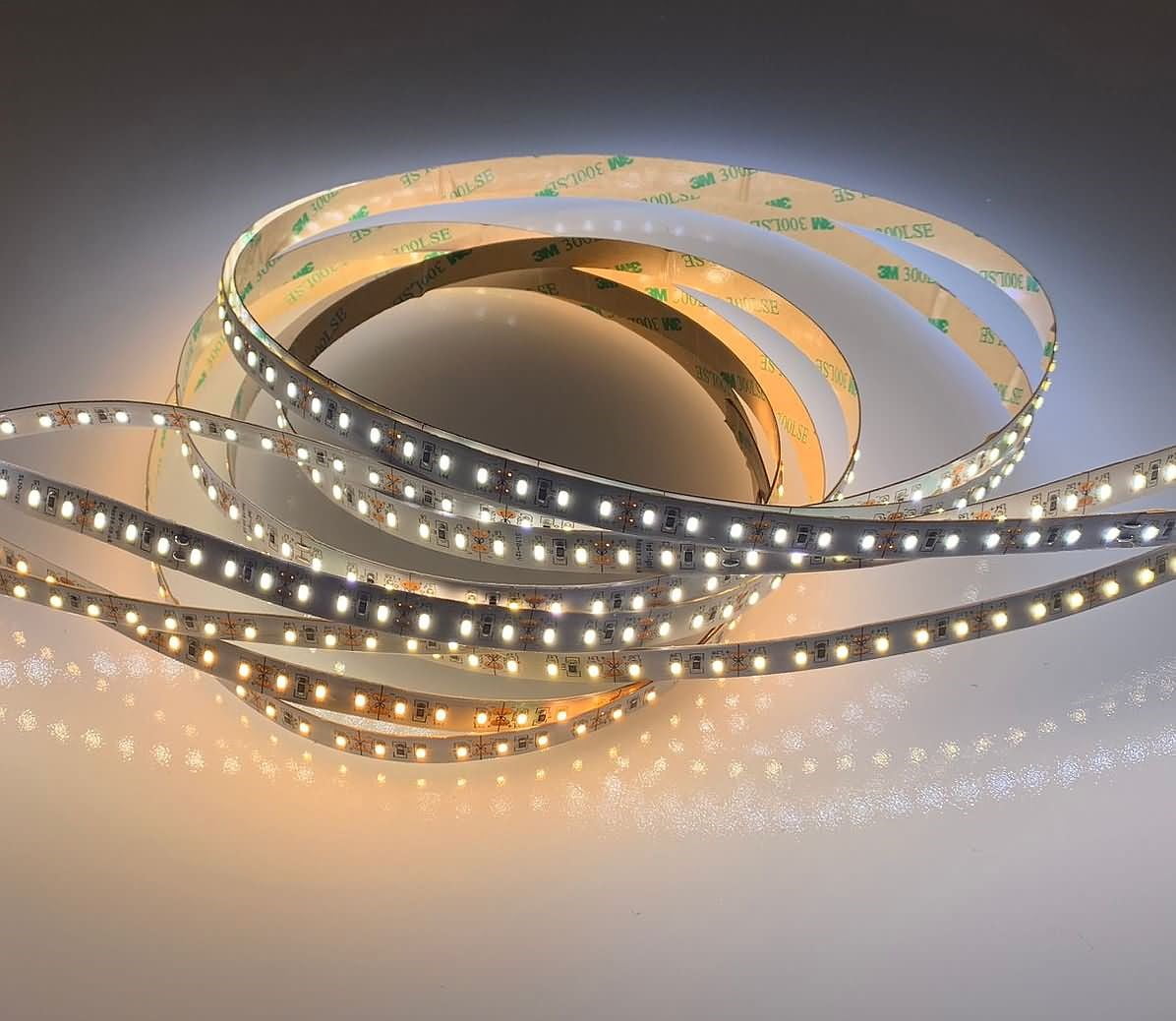
LED strip lighting has expanded into one of the most widely used formats precisely because it adapts to surfaces and spaces that conventional fixtures cannot. Under-cabinet illumination, architectural cove lighting, staircase accent lighting, display case lighting — strips make these applications practical.
The variables in strip selection extend well beyond what a bulb replacement involves. LED density per metre affects whether the light appears as a smooth glow or as discrete point sources. Ingress protection ratings determine suitability for kitchen and bathroom environments. Compatibility between strips, drivers and controllers matters enormously and is easily overlooked when purchasing components separately.
What a planned approach saves versus an improvised one
- Calculating total lumen requirements before buying avoids the common outcome of either dim, inadequate illumination or harsh over-lighting
- Selecting consistent colour temperature across adjacent spaces creates visual coherence rather than jarring transitions
- Specifying dimmable sources from the outset is far simpler than retrofitting dimming capability into a completed installation
- Confirming driver wattage capacity against total strip load prevents premature driver failure in strip installations
- Choosing fixtures appropriate for their environment — IP-rated for wet areas, thermally adequate for enclosed spaces — avoids the early failures that give LED lighting an undeserved poor reputation
Before purchasing any LED installation, write down what you actually need from the light in each space: the activity it needs to support, how flexible you need the light level to be, whether colour accuracy matters, and what the ambient temperature range will be. These four questions, answered honestly, make product selection significantly more straightforward and significantly more likely to produce results that work well from the day they are installed.
Good LED lighting is genuinely transformative — it makes spaces feel better, costs less to run and requires less maintenance than anything it replaces. The gap between a mediocre LED installation and an excellent one is almost entirely explained by specification decisions made before a single product is purchased.